

Venous Leg Ulcer Treatment in San Antonio, Texas
Hill Country Wound Care and Hyperbarics provides physician-led venous leg ulcer treatment at three locations serving Greater San Antonio: Bulverde (32357 US-281, Bulverde, TX 78163), Live Oak (12215 Toepperwein Road, Live Oak, TX 78233), and Southwest San Antonio (7127 Somerset Rd, San Antonio, TX 78211). Our board-certified wound care and vascular specialists diagnose and treat venous stasis ulcers (also called venous insufficiency ulcers or chronic venous ulcers) using evidence-based therapies including multi-layer compression therapy, Doppler ultrasound assessment, sharp debridement, advanced wound dressings, biologic skin grafts (amnion/chorion membrane), and hyperbaric oxygen therapy (HBOT) for non-healing ulcers.
Understanding Venous Leg Ulcers
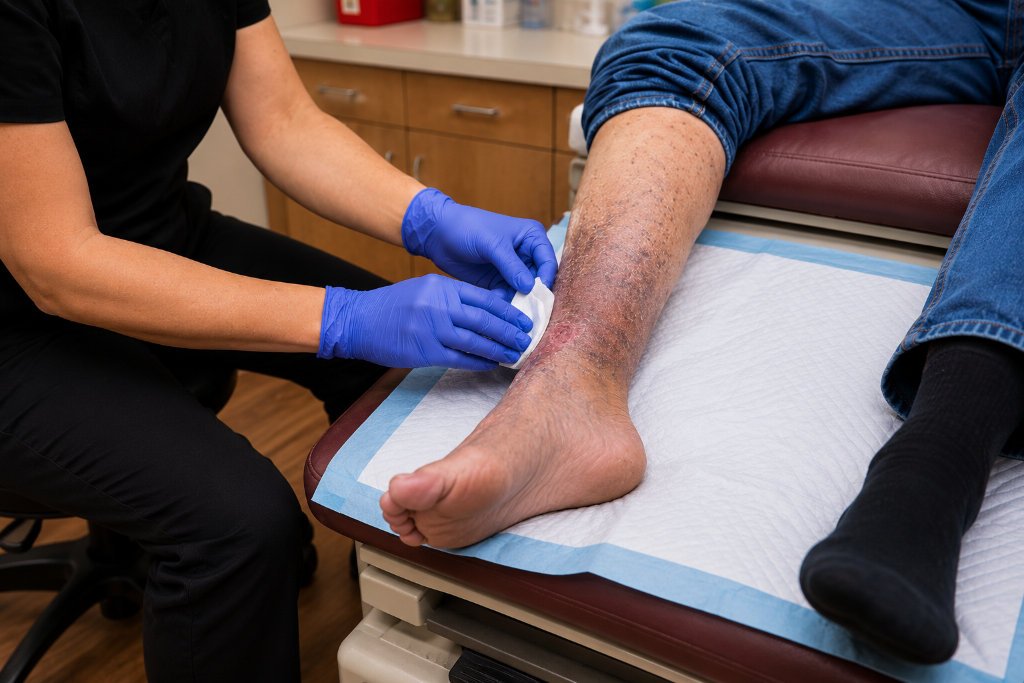
Venous leg ulcers are open wounds on the lower leg or ankle caused by chronic venous insufficiency — a condition where one-way valves in leg veins fail, allowing blood to pool in the lower extremities. This venous hypertension stretches skin, reduces oxygen delivery, and creates wounds that cannot heal without addressing the underlying venous disease. Venous ulcers account for up to 80% of all chronic leg ulcers, affecting 1-2% of adults, with a 70% recurrence rate within three years without proper compression therapy. Common symptoms include swollen ankles and legs (edema), brown or reddish skin discoloration near the ankle, hard leathery skin (lipodermatosclerosis), shallow irregularly shaped wounds on the inner ankle (medial malleolus), moderate-to-heavy wound drainage, varicose veins, and leg heaviness or aching.
Comprehensive Venous Ulcer Treatment Protocol
Our physician-led approach begins with comprehensive evaluation including wound assessment and staging, Doppler ultrasound to identify venous reflux and valve failure, ankle-brachial index (ABI) to rule out arterial disease, and infection screening. Treatment includes multi-layer compression therapy (gradient compression wraps and medical-grade stockings applying 30-40 mmHg or 40-50 mmHg pressure) to reduce venous hypertension; sharp debridement to remove devitalized tissue and biofilm; advanced wound dressings (foam, hydrocolloid, alginate, antimicrobial silver/iodine/medical-grade honey) tailored to wound characteristics; biologic skin grafts (amnion/chorion membrane allografts) rich in growth factors for ulcers failing to progress; hyperbaric oxygen therapy (HBOT) for non-healing venous ulcers after 4-6 weeks of standard care; leg elevation guidance to reduce edema; and patient education on compression stocking use, skin care, and lifestyle modifications to prevent recurrence.
Compression Therapy: The Gold Standard
Compression therapy is the cornerstone of venous ulcer healing and recurrence prevention. By applying graduated pressure (highest at the ankle, decreasing toward the calf), compression wraps and stockings help push pooled blood back up the leg, reducing venous hypertension and restoring normal microcirculation. Our physicians fit patients with appropriate compression levels based on ABI results and wound severity: multi-layer compression wraps for active ulcers (providing 30-40 mmHg or 40-50 mmHg), medical-grade graduated compression stockings for maintenance (20-30 mmHg, 30-40 mmHg, or 40-50 mmHg), and adjustable compression wraps for patients with irregular leg shapes or difficulty applying traditional stockings. Proper compression reduces healing time from months to weeks and decreases recurrence rates from 70% to under 20% when worn consistently.
Advanced Therapies for Non-Healing Venous Ulcers
For venous ulcers that fail to progress after 4-6 weeks of standard compression and wound care, we offer advanced therapies including biologic skin grafts (amnion/chorion membrane allografts) that provide growth factors and extracellular matrix scaffolding to jump-start healing; hyperbaric oxygen therapy (HBOT) where patients breathe 100% oxygen at 2.0-2.5 ATA for 90-120 minutes per session, typically 20-40 sessions, increasing dissolved oxygen in plasma to promote angiogenesis and fibroblast activity; and cellular tissue products providing bioengineered skin substitutes for large or chronic ulcers. These advanced modalities are used when standard compression therapy alone is insufficient.
Insurance Coverage for Venous Ulcer Treatment
Medicare Part B covers medically necessary venous ulcer treatment including physician visits, Doppler ultrasound, compression therapy (wraps and stockings when medically necessary), debridement (CPT codes 11042-11047), biologic skin grafts (CPT codes 15271-15278), and HBOT for qualifying non-healing ulcers. Most major insurance plans including Blue Cross Blue Shield of Texas, Aetna, United Healthcare, Cigna, Humana, TriCare, and CHAMPVA provide coverage when documentation supports medical necessity. Our care coordinators verify insurance benefits, obtain prior authorizations for advanced therapies and biologics, and provide cost estimates before treatment begins. Self-pay options and payment plans are available for uninsured patients.
Preventing Venous Ulcer Recurrence
Venous ulcers recur in up to 70% of patients within three years without ongoing compression therapy. Our recurrence prevention program includes lifelong daily wear of medical-grade compression stockings (20-30 mmHg or 30-40 mmHg), regular leg elevation above heart level, daily walking and calf muscle exercises to activate the calf muscle pump, weight management to reduce venous pressure, skin care with moisturizers to prevent cracking and breakdown, prompt treatment of new wounds or skin changes, and regular follow-up with our wound care team. Patient education and adherence to compression therapy are the most critical factors in preventing recurrence.
How to Schedule a Venous Ulcer Evaluation
Patients can self-refer or be referred by primary care physicians, vascular surgeons, podiatrists, or other specialists. Call (210) 610-8154 to schedule a comprehensive venous ulcer evaluation at any of our three locations. Most patients are seen within 48 hours. Same-day appointments may be available for urgent cases with signs of infection (increased pain, erythema, warmth, purulent drainage, fever) or rapidly worsening wounds. Online appointment requests are available through our website. Our clinics are located in Bulverde (serving Spring Branch, Canyon Lake, Boerne, and northern Comal County), Live Oak (serving Northeast San Antonio, Converse, Universal City, Schertz, and Selma), and Southwest San Antonio (serving Lackland AFB, Helotes, Leon Valley, and southwest Bexar County).
Dr. Cascio Explains Venous Leg Ulcers
The Venous Ulcers page includes a short educational video, "Dr. Cascio Explains Venous Leg Ulcers," in which Dr. Michael Cascio, Chief Medical Officer and board-certified wound care physician at Hill Country Wound Care and Hyperbarics, explains what venous leg ulcers are, how chronic venous insufficiency causes them, and how physician-led wound care treats them. The video is embedded from YouTube (video ID V218kFsKkJA) and is marked up with VideoObject structured data that identifies Dr. Cascio as the physician provider, supporting medical expertise, authoritativeness, and trustworthiness (E-E-A-T) signals for the page.